I recently published a chapter in the De Gruyter Handbook of Political Control edited by Jennifer Earl and Jessica Maves Baithwaite. This chapter pulls together some theoretical discussions about repression and social control that I wrote some time ago but never published.
The abstract is: This chapter provides theoretical tools for understanding the differential repression of racial and ethnic minorities. Political repression and crime control are analytically the same problem of social control and intertwined in practice. Implicit models of the relation between regime, society, and criminals or dissidents obscure the commonalities. Regimes often favor some subgroups in society. Criminals, dissidents, and regimes are all parts of the same society. Typically, subpopulations vary in their power and ability to affect or control the actions of the regime. Crime control can have the consequence of repressing dissent. Effective deterrence can be invisible. Strategies of incapacitation inevitably involve pretexts for arrest and incarceration. Pacification is a colonial logic that combines coercive control of subpopulations with rewards to cooperative members of those populations who agree to submit to the regime. Subpopulations may compete for control of the social control system itself. Horizontal conflict between subpopulations may have the effect of social control. Backlash against repression is conditioned by the relation between the repressed group and the majority of the society.
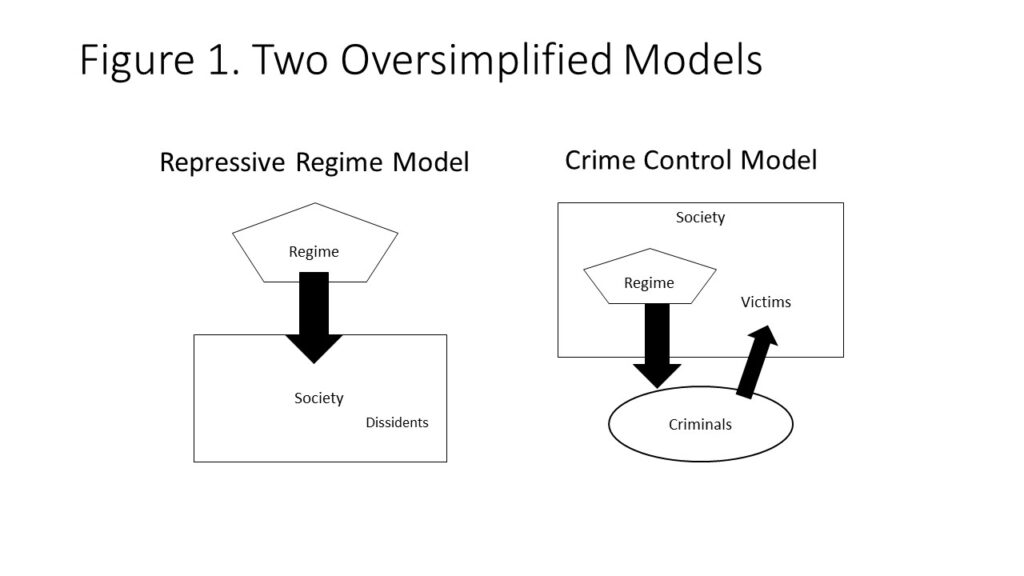
One part of this paper is to contrast two oversimplified models of the problem of social control, the models of repression and crime control with a more realistic model. In the oversimplified repression model the regime is outside society and the dissidents are in society. In the oversimplified crime control model, criminals are outside society and the regime and victims are in society. But in reality, everyone is in society.
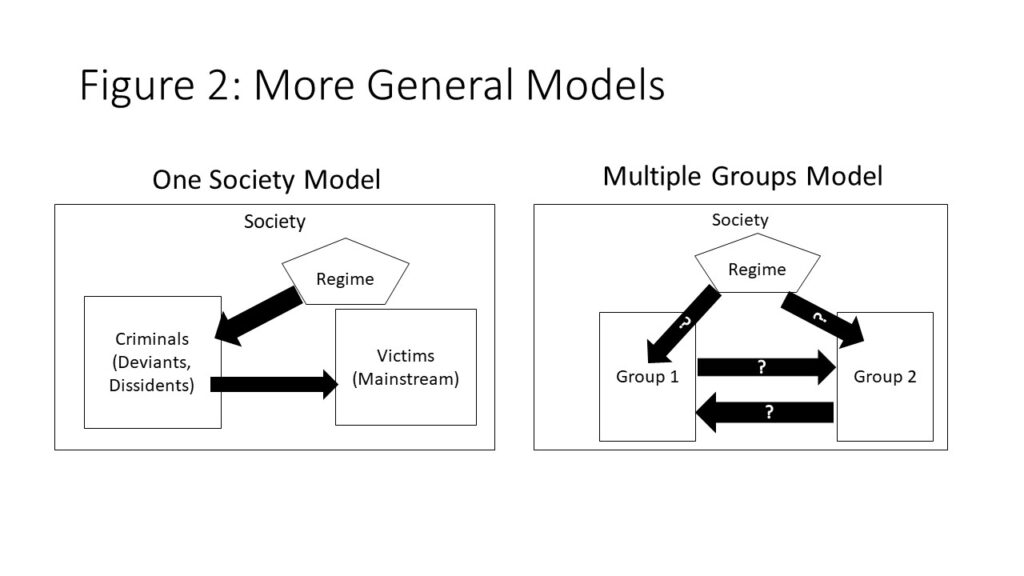
In the more realistic model on the left, everyone is in the society. But in fact, regimes are almost always biased and treat some subgroups in society better than other subgroups. And the subgroups may harm or benefit each other.
In case you are interested, I’m posting a “green” preprint of this chapter here. This version is before the final copyediting and proofreading. The citation to the published version is: Pamela Oliver. “Social Control of Racial and Ethnic Minorities. Pages 191-209 in Jennifer Earl and Jessica Maves Braithwaite, editors, De Gruyter Handbook of Political Control. Berlin: Walter de Gruyter. 2026


